Monday, September 22, 2014
Role Models Helped my Students Believe in Themselves
I am very proud of myself for finding a way to contact living role models that my students admired, who would hopefully in turn inspire my students.
I began this 7-8 years ago while teaching at an underprivileged school. My 4th grade students didn't believe in themselves and didn't care if this new teacher called Mr. Stuart believed in them either.
So I thought, "What if I can contact people they do care about to send them a signed picture with a message of inspiration?"
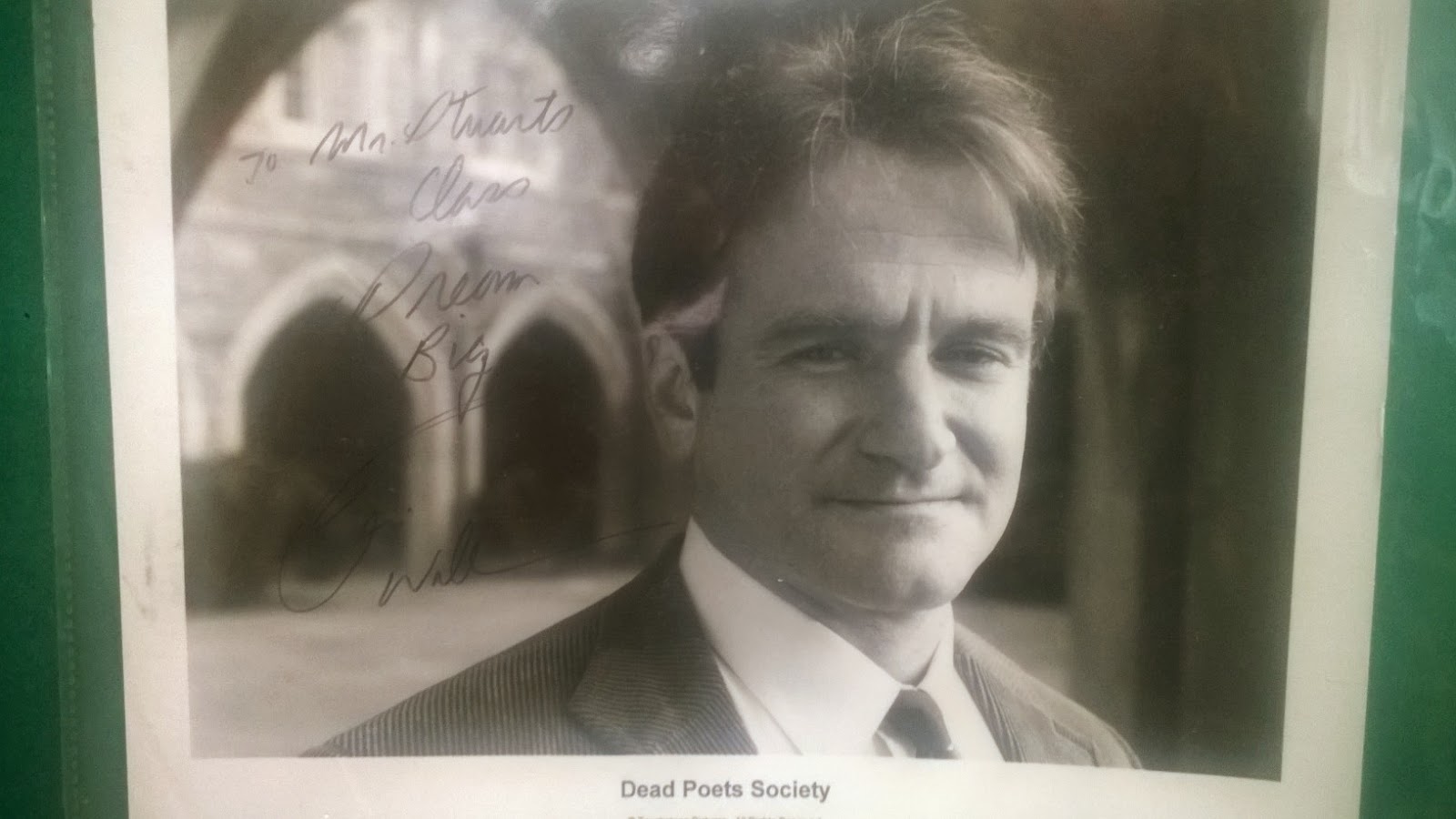
Robin Williams (above), John Travolta, Jeff Goldblum, Eddie Murphy, Denzel Washington, Tate Donovan, Brian Donovan, Tony Horton, Jennifer Aniston, Matt LeBlanc, the cast of Will & Grace, Marc Mero, and others all responded.
I'm home recuperating after surgery and will post their pictures when I return to work.
These people fought hard to believe in themselves UNTIL their dreams became a reality, and have helped my students each year do the same.
For that I am very proud of making happen :-)
*This blog is dedicated to Robin Williams, whose performance in Dead Poets Society inspired me to leave business and become a teacher.
30 Day Blog Challenge ~ Teach Thought ~ One of Your Biggest Accomplishments in Your Teaching that No One Knows About (and might not care)
What's in Your Desk Drawer? ~ O Captain! My Captain!
What is in your desk drawer, and what can you infer from those contents?
This one makes me laugh, because my desk drawer, as well as my entire desk, has been given to my students.
It is no longer a teacher's desk, but a news desk, a TV show host's desk, a sports desk, a weather desk and a game show host's desk.........and a stand up and stand on to look at things in another way desk!
So as to what's in the drawer. I don't know. I'd have to ask the kids :-)
But I do know that Robin Williams' character, John Keating, would be proud :-
Friday, September 12, 2014
True Teaching Collaboration in Action
Teach Thought 30 Day Challenge ~ Day 7 ~ Who is or was your most inspirational colleague?
Today is actually Day 12 of the 30 Day Challenge, but due to moving into a new apartment this weekend and an aggravated health concern that has moved my surgery up to this Tuesday I've gotten behind. It is my intention before Tuesday to catch up!
As promised from Day 6's blog, here is the picture Robin Williams sent me.
His role in Dead Poet's Society is what made me want to leave the riches of the business world and enter the world of education to enrich others as he did in the movie.
I owe him a lot and dedicate my these blogs to him. I hope to contact his wife some day and let her know how much Robin touched my life and continues to touch the lives of my students year after year.
The colleague who has inspired me the most is our art teacher here at Sand Lake Elementary, Beth Elliston.
She cares so much for her students that she transforms her room each year to create an experience they will never forget. One year it was a giant iPad, the next the Tardis from the British show Doctor Who, and this year it's Sherlock Holmes from the BBC.
I've never seen a specials teacher more committed to creating an entire experience that leads to a huge increase in learning. Before her an art teacher was just an art teacher. Now an art teacher is a developer of the mind.
Secondly, she is an amazing collaborator. She helped me transform my room into the famous art museum in Paris, the Louvre, where students spent the year transforming themselves into masterpieces. The next year she encouraged me to transform my room into a giant ship where my students travelled and explored the world of knowledge. This year it's a TV studio with a Tardis where we are time-travelling scientists using reading and math skills to interview famous people while we navigate the past, present and future.
Yet she didn't stop there. She would ask me and other teachers what standards we were teaching and spend hours figuring out how to integrate them into her art lessons.
More than once I and the other "regular teachers" would hear our students make connections to the big ideas of reading, science or math that we were teaching. When we asked with pride, "You remember that from when we went over it in class?" we heard, "No, I learned it in art class".
It's true what Marzano says about multiple exposures being needed for knowledge to truly take hold in the mind.
Because of this we are truly lucky to have her teaching the way she does in our school.
Through her caring, creativity and collaboration, Beth Elliston has not only taken teaching art out of the dark ages, but helped me take my own teaching own teaching farther than I've ever been able to on my own.
Today is actually Day 12 of the 30 Day Challenge, but due to moving into a new apartment this weekend and an aggravated health concern that has moved my surgery up to this Tuesday I've gotten behind. It is my intention before Tuesday to catch up!
As promised from Day 6's blog, here is the picture Robin Williams sent me.
I owe him a lot and dedicate my these blogs to him. I hope to contact his wife some day and let her know how much Robin touched my life and continues to touch the lives of my students year after year.
The colleague who has inspired me the most is our art teacher here at Sand Lake Elementary, Beth Elliston.
She cares so much for her students that she transforms her room each year to create an experience they will never forget. One year it was a giant iPad, the next the Tardis from the British show Doctor Who, and this year it's Sherlock Holmes from the BBC.
I've never seen a specials teacher more committed to creating an entire experience that leads to a huge increase in learning. Before her an art teacher was just an art teacher. Now an art teacher is a developer of the mind.
Secondly, she is an amazing collaborator. She helped me transform my room into the famous art museum in Paris, the Louvre, where students spent the year transforming themselves into masterpieces. The next year she encouraged me to transform my room into a giant ship where my students travelled and explored the world of knowledge. This year it's a TV studio with a Tardis where we are time-travelling scientists using reading and math skills to interview famous people while we navigate the past, present and future.
Yet she didn't stop there. She would ask me and other teachers what standards we were teaching and spend hours figuring out how to integrate them into her art lessons.
More than once I and the other "regular teachers" would hear our students make connections to the big ideas of reading, science or math that we were teaching. When we asked with pride, "You remember that from when we went over it in class?" we heard, "No, I learned it in art class".
It's true what Marzano says about multiple exposures being needed for knowledge to truly take hold in the mind.
Because of this we are truly lucky to have her teaching the way she does in our school.
Through her caring, creativity and collaboration, Beth Elliston has not only taken teaching art out of the dark ages, but helped me take my own teaching own teaching farther than I've ever been able to on my own.
Saturday, September 6, 2014
Mentors Live in Your Heart and Head ~ Thank You Robin Williams
What does a good mentor do?
It gets you to be a reflective teacher by asking yourself relevant questions on a daily basis.
Among the many things a mentor can do, inspiring you to become the best possible teacher you can be, for me, is among the most important.
In addition to seeing my fellow teachers as mentors and trying to find out what I can learn from those at my school and meet in trainings, I also find inspiration and enlightenment from those "teachers" who are no longer living, but still very much alive inside of my heart and head.
They keep me on track and fill my head with new ideas, help keep my head up when things get tough, and fill my heart with courageous energy to take my students' potential and work with them to turn it into their ongoing and unlimited reality.
These are probably the top six that I find myself using every week.
Socrates
470 BCE - 399 BCE
“Education is the kindling of a flame, not the filling of a vessel.”
Am I doing nothing more than temporarily filling their neurons with knowledge for a test, or am I helping them making connections between those neurons, setting fire to their synapses as the electrical charges build a powerful, neural network that will be alive and on fire forever?
"I cannot teach anybody anything, I can only make them think."
Do my students hear me saying, "Teachers don't tell you what to think, they get you to think?"
"Wonder is the beginning of wisdom."
How often are my students filled with wonder about the content I'm teaching?
How passionate and hungry are they to learn it?
Am I helping them return to the time when they were natural scientists, wondering about everything and discovering answers through experience, before they came to school and were told to be quiet, sit still, and know this stuff for a test?
Plato
428 BCE - 348 BCE
“Do not train a child to learn by force or harshness; but direct them to it by what amuses their minds, so that you may be better able to discover with accuracy the peculiar bent of the genius of each.”
Do I find myself frustrated and feeling tense because, without realizing it, I'm trying to get caught up and trying to force learning down their throats?
Have I stopped to ask myself why each one of my students might want to learn what I'm trying to teach?
"You can discover more about a person in an hour of play than in a year of conversation.”
Am I listening to this wisdom that's been around for @2,500 years, or am I falling back on how I was taught 20-40 years ago?
Am I becoming smart enough to figure out how to integrate as much play into my teaching as possible in the form of pre-assessments, helping students interact with new knowledge through direct instruction, formative assessments, practicing and deepening knowledge, and helping students generate and test hypotheses?
“Never discourage anyone...who continually makes progress, no matter how slow.”
How effectively am I really encouraging my students with clear and appropriate learning targets, motivating scales that reward them for partial progress along the way, and instruction that makes clear the critical information?
Aristotle
384 BCE - 322 BCE
genius.com
“Educating the mind without educating the heart is no education at all.”
Are my students in my heart as well as in my classroom? Can they feel that I believe in them and am willing to work with them to "love" their potential into existence?
"Those that know, do. Those that understand, teach."
Are my students able to understand what they're learning well enough to show what they know by teaching it to others?
"Happiness is the meaning and the purpose of life, the whole aim and end to human existence."
Are my students happy? Am I? Are we having a good time together?
"Tell me and I'll forget; show me and I may remember; involve me and I'll understand."
Are my students involved in the lesson by playing with the new knowledge and creating artifacts and evidence of knowledge mastery and ability?
"The object of education is to prepare the young to educate themselves throughout their lives."
Am I making sure they can prove their answers on a test? How often am I asking them how they know what they know? Am I really emulating the motto of London's Royal Society of knowledge, Nullius in Verba, not taking my word for it, but seeing it for themselves.
If this was good enough for King Charles II, Christopher Wren, Robert Boyle, Robert Hooke and Isaac Newton, it's certainly good enough for my students too.
Thomas Edison
1847 CE - 1931 CE
“I have not failed. I've just found 10,000 ways that won't work.”
How many times am I willing to continuing trying, no matter how many times I may continue failing, until I succeed in turning on the light inside of every one of my students?
"Five percent of people think;
ten percent of the people think they think;
and the other eighty-five percent would rather die than think."
Are 100% of my students really thinking? Am I? Are we spending rigorous time generating and testing hypotheses?
“If we all did the things we are really capable of doing, we would literally astound ourselves.”
Do I believe this to be truth? Am I getting my students to believe this truth about themselves by helping them succeed beyond anything they've ever done or believed they could do?
“Our greatest weakness lies in giving up. The most certain way to succeed is always to try just one more time.”
Am I getting my students to never give up on themselves by never giving up on them?
Albert Einstein
1879 CE - 1955 CE
Am I differentiating my instruction to my student's unique particular talents, letting a fish excel as a fish, a squirrel excel as a squirrel, and a bird excel as a bird?
"Imagination is more important than knowledge."
Knowledge is the start, but am I requiring my students to do anything with it? It's important to know how to ride a bike, but more important to be able to ride a bike. What new knowledge and ability am I asking my students to create with it via their imaginations.
"Anyone who has never made a mistake has never tried anything new."
Am I encouraging courage and confidence in my students by telling them, "If you're not making new mistakes, you're not trying hard enough. If you're making the same mistakes over and over, you're not trying hard enough"?
"The only thing that interferes with my learning is my education."
Unfortunately, most great thinkers hated their formal education, Leonardo Da Vinci included. Fortunately, they became wanted to really think and learn so much that they learned how to teach themselves and became the self-learners we strive so hard to instill in our students today.
Am I making sure that my instruction is not interfering with my students real and long-lasting learning?
Am I getting them to act as quantum scientists, becoming self-learners through the play and display of their own potentiality?
Martin Luther King, Jr.
1929 CE - 1968 CE
"The function of education is to teach one to think intensively and to think critically. Intelligence plus character - that is the goal of true education."
Am I spending enough time in the deepening and practicing and generating and testing hypotheses phases that allow my students to think critically?
Am I also monitoring their intra and interpersonal intelligence on how well they know and control themselves and how well they know and seek to understand others?
"The ultimate measure of a man is not where he stands in moments of comfort and convenience, but where he stands at times of challenge and controversy.”
When my students fail, do I share this wisdom with them? Do I tell them that they are literally writing the amazing story of their own lives by never giving up, never giving in, in rising each time they fall and are afraid?
“I have a dream that my four little children will one day live in a nation where they will not be judged by the color of their skin but by the content of their character.”
MLK had a big, beautiful, powerful dream. He didn't have a weak wish or half-hearted hope that one day his four little children would be judged by the content of their character and not by the color of their skin.
Is my dream of what could happen with my students just as big, beautiful and powerful?
Do I dream big, do big and become big in every cell of my body for every one of my students?
Robin Williams
1951 CE - 2014 CE
Robin Williams' performance in Dead Poets Society was what made me want to become a teacher. I had been in business for 10 years and no matter how well I did I was bored and wondered what I was doing with my life.
I wrote to him and thanked him for inspiring me and helping me find a job I would do for free (my mother's advice to me when I went to college).
I asked him if he could send a picture to my class with an inspirational message. He sent back a signed picture with the words, "To Mr. Stuart's class, Dream Big!"
From that I made my class motto, "Dream Big, Do Big, Be Big!"
I want to dedicate these blogs to the man that inspired me to spend the rest of my life trying to inspire others. Thank you Robin, you live on in my heart and head and classroom every day.
The picture is in my classroom and I'll include it on Monday's post.
Day 6 of Teach Thought ~ Think Better 30 Day Blogging Challenge
Friday, September 5, 2014
What Do You See in Your Classroom? ~ What Would You Like to See?
30 Day Blog Challenge ~ Day 5 ~ Post Pictures of Your Classroom
I see a classroom turned into a ship that explores the New World and a "captain" that is having fun and fully committed to his students.
Last year my students had to pass their social studies assessment in order to board the ship, pass their reading assessment in order to help navigate the ship, become a royal scientist on board the ship, survive mad math monkey island to continue voyage on the ship, and be able to write about the journey to the king and queen who funded the trip.
What I don't see are academic obstacle courses which I'm adding this year as a result of my LSI (Learning Science International) trainings that I'm going to as a result of our school becoming a Marzano demonstration school.
It's frustrating because of all the time spent out of the classroom to go to these extra trainings, but all the more rewarding as I come back with increased understanding of how to implement these big ideas of what my classroom can be!
Dream Big! Do Big! Become Big!
Find the hero in you, and you'll be able to find the hero in your students!
Thursday, September 4, 2014
Love Success Into Existence
30 Day Blogging Challenge ~ Day 4 ~ What Do I Love About Teaching?
What do I love about teaching?
The love.
When we are learning how to walk, we are completely believed in, completely cared for, completely encouraged.
Our ability to walk is literally loved into existence.
If we teach the same way, completely believing in all of our students, completely caring for each one, completely encouraging them......we will literally love their ability to succeed into existence.
What do I love about teaching?
The love.
When we are learning how to walk, we are completely believed in, completely cared for, completely encouraged.
Our ability to walk is literally loved into existence.
If we teach the same way, completely believing in all of our students, completely caring for each one, completely encouraging them......we will literally love their ability to succeed into existence.
Wednesday, September 3, 2014
Day 3 ~ An Area(s) I'd like to Improve In - There's at Least 51
30 Day Blog Challenge ~ Day 3 ~ Discuss one "observation" area that you would like to improve on for your teacher evaluation
I want to work on them all, because I need to work on them all. There's not one strategy that I can't become better at.
When I'm not sure of what action to take, I tend to gather more information. According to Marzano research, students should clearly understand the purpose of what they are learning and why they are learning it.
I remember the feeling being that students should simply understand what they were learning.
Now it's the purpose for it (so they can relearn how to use their brains to think and solve problems) and why (so they can succeed and achieve their most important dreams.....and NOT to get a good job and settle for a wake up, go to work, come home, go to bed, lather-rinse-repeat kind of life)
And if I'm ever going to help them become these powerfully positive thinkers who can leap tall problems in school and in life in a single bound, don't they have to first clearly know what they're learning and why?
So there, problem solved. I will focus on Element 8 ~ Previewing New Content, to make sure each and every one of my students knows the purpose of what they're learning and why.
Oh yeah, for my observation I guess too........... How about if I focus on being an effective teacher instead of worrying about being seen as one.
It's like I challenge my students; Don't worry about getting an A. Focus on learning how to think, and I guarantee you, the A's will come.
I want to work on them all, because I need to work on them all. There's not one strategy that I can't become better at.
When I'm not sure of what action to take, I tend to gather more information. According to Marzano research, students should clearly understand the purpose of what they are learning and why they are learning it.
I remember the feeling being that students should simply understand what they were learning.
Now it's the purpose for it (so they can relearn how to use their brains to think and solve problems) and why (so they can succeed and achieve their most important dreams.....and NOT to get a good job and settle for a wake up, go to work, come home, go to bed, lather-rinse-repeat kind of life)
And if I'm ever going to help them become these powerfully positive thinkers who can leap tall problems in school and in life in a single bound, don't they have to first clearly know what they're learning and why?
So there, problem solved. I will focus on Element 8 ~ Previewing New Content, to make sure each and every one of my students knows the purpose of what they're learning and why.
Oh yeah, for my observation I guess too........... How about if I focus on being an effective teacher instead of worrying about being seen as one.
It's like I challenge my students; Don't worry about getting an A. Focus on learning how to think, and I guarantee you, the A's will come.
Subscribe to:
Posts (Atom)


